















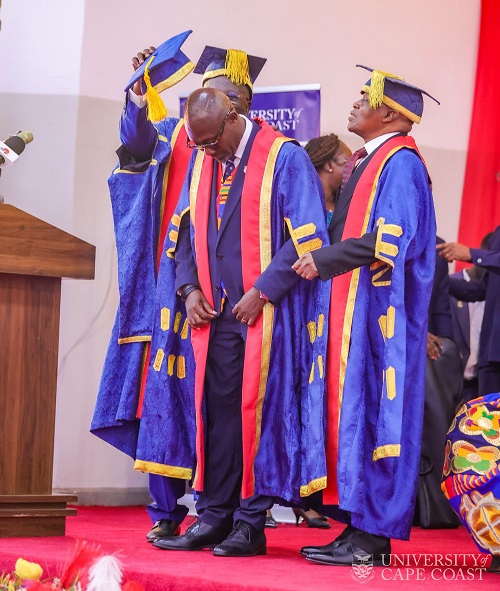
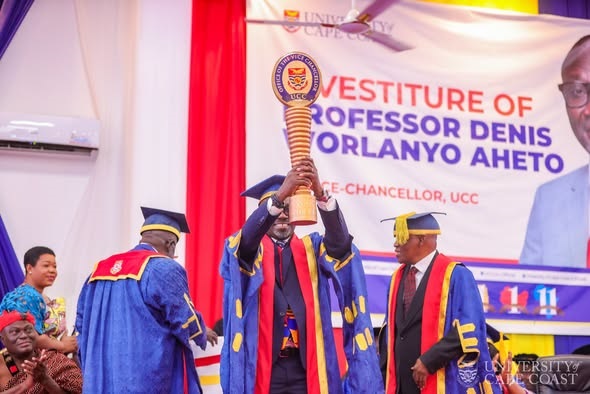
The newly invested Vice-Chancellor of the University of Cape Coast (UCC), Professor Denis Worlanyo Aheto, has, unveiled a four-year plan to reposition the university as a globally competitive and digitally driven institution through an artificial intelligence-powered e-Campus, new academic programmes and research institutes, tighter financial governance and improved staff and student welfare.
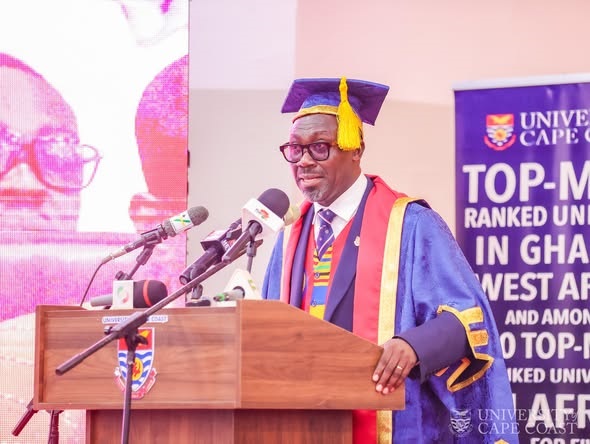
Professor Aheto announced the agenda during his investiture as the 12th Vice-Chancellor of UCC in Cape Coast, explaining that the reforms were intended to strengthen teaching, research, innovation and community engagement while responding to financial pressures and rapid changes in higher education.
A major component of the plan is the establishment of the UCC e-Campus in partnership with Astra Learning.
Professor Aheto said the Ghana Tertiary Education Commission (GTEC) had approved the fully digital platform, which was expected to enrol about 10,000 students annually.
He added that approximately 36 master’s, Doctor of Business Administration and PhD programmes had already received accreditation, with the first cohort expected to begin studies in the 2026/2027 academic year.
The programmes include an MSc in Cyber Security, an MBA in Sustainability and Governance Management, a Doctor of Business Administration in Financial Analysis and Management, a PhD in Artificial Intelligence and a PhD in Digital Transformation.
Professor Aheto stressed that the e-Campus would not replace the university’s regular, distance and sandwich programmes.
“The e-Campus is an additional pathway that expands access to quality higher education, enhances flexibility for learners and positions the University of Cape Coast to meet the evolving demands of higher education in the digital age,” he said.
New colleges and institutes
Professor Aheto also announced plans to establish a College of Engineering and Built Environment to strengthen engineering education, applied research and collaboration with industry.
The university would further introduce programmes in Veterinary Medicine, Dentistry, Architecture, Estate Management, Special Languages, Cultural Heritage Studies and other emerging fields.
Industry-focused micro-credentials and professional short courses would also be introduced to improve graduate employability and respond more quickly to changing labour-market demands.
Professor Aheto disclosed that GTEC had approved the establishment of the Africa Ocean Institute at UCC.
The institute would bring together the Centre for Coastal Management, the Department of Fisheries and Aquatic Sciences and the Centre for Marine Affairs under one interdisciplinary framework.
It would serve as a continental hub for ocean research, marine governance, fisheries management, coastal resilience, policy engagement and blue-economy development.
The university had also received approval to establish the Africa Centre for Food Integrity, which would promote research and training in food safety, agricultural innovation and sustainable food systems.
Professor Aheto said the two institutions would connect scientific research with public policy, industry and community needs.
Five strategic priorities
The Vice-Chancellor said his administration would pursue five strategic priorities over the next four years.
They are sustainable financing and resource mobilisation; stronger institutional governance and staff development; research excellence and knowledge transfer; improved teaching and digital learning; and diversity, equity, inclusion and well-being.
“My vision as Vice-Chancellor of the University of Cape Coast is to provide strategic leadership to foster a transformative, inclusive and diverse academic environment that empowers excellence in research, teaching and learning, and outreach for wider impact on society,” he said.
Professor Aheto acknowledged that the university faced financial challenges, including liquidity constraints, outstanding commitments, budget deficits and insufficient cash flow.
Read Also: Archbishop of Canterbury Apologizes for Slave Trade Atrocities in Ghana
He said his administration would enforce prudent financial management, comply strictly with procurement regulations and increase revenue through research, partnerships, investments and the commercialisation of innovation.
The university would also strengthen its grant-support systems and fully operationalise its Technology Transfer Office to convert research findings into commercially viable products and services.
Although UCC continued to produce competitive research, Professor Aheto said commercialisation remained limited.
His administration would therefore encourage high-impact publications, interdisciplinary research, entrepreneurship and partnerships with the private sector and development institutions.
AI policy, smart classrooms
Professor Aheto announced that UCC would develop a comprehensive artificial intelligence policy and build an AI-powered digital campus ecosystem.
The university would establish smart lecture theatres, expand digital library resources, improve video-conferencing facilities for postgraduate examinations and strengthen internet connectivity in academic and administrative areas.
Each college would eventually have at least one smart lecture theatre equipped to support technology-enhanced and hybrid teaching.
Additional lecture theatres would be constructed, while existing classrooms, laboratories and office facilities would be rehabilitated.
The university would also improve physical and digital access for students with disabilities.
Professor Aheto said the Presidential Library of former President John Evans Atta Mills would be brought into full operation as an additional academic and research facility.
Governance reforms
To improve accountability, the Directorate of Academic Planning and Quality Assurance would be restructured into the Directorate of Academic Planning, Monitoring, Evaluation and Quality Assurance.
Professor Aheto explained that the restructuring would integrate monitoring and evaluation into academic planning and allow the university to track institutional performance more effectively.
A monitoring and evaluation system would also be extended to the various colleges.
Administrative processes would be digitised, while financial approvals and travel authorisations would continue to be decentralised to reduce bureaucracy and improve efficiency.
The university would introduce merit-based human resource systems, structured leadership development, mentoring and participatory governance involving the Governing Council, Convocation and staff unions.
Professor Aheto said UCC had nearly 10,000 direct and indirect employees, with about 1,349 staff members aged above 50.
He said the ageing workforce, staff shortages and inadequate welfare systems required urgent attention.
Environmental sustainability
A Sustainability Office would be established under the Office of the Vice-Chancellor to coordinate environmental initiatives.
The office would promote solar-energy systems, recycling, energy efficiency and climate-smart campus development.
It would also monitor the university’s carbon footprint and provide technical support for environmental sustainability projects across the institution.
Graduate education
Professor Aheto said the School of Graduate Studies would be strengthened through digital supervision systems, improved support for academic assessors and sustained mentorship for postgraduate students.
The university would target more international students and expand joint and dual degree programmes, student exchanges and collaborative PhD programmes with foreign institutions.
Specialised graduate training hubs would be developed around institutions such as the Africa Ocean Institute, the Institute for Educational Planning and Administration and the College of Distance Education.
The centres would offer professional master’s and doctoral programmes tailored to working professionals.
“Our goal is to produce graduates who are adaptable, innovative, globally competitive, career-ready and employable,” Professor Aheto said.
Community engagement
The Vice-Chancellor said the university would strengthen its relationship with the approximately 11 communities surrounding its campuses.
Management would hold regular consultations with traditional leaders, opinion leaders and the Cape Coast Metropolitan Assembly to address land encroachment, private student accommodation, security and corporate social responsibility.
He said closer engagement would promote peaceful coexistence and ensure that surrounding communities benefited from the university’s development.
Diversity and inclusion
Professor Aheto pledged to integrate diversity, equity and inclusion into governance, recruitment, admissions and leadership development.
He identified gender imbalance in senior positions, unequal access for economically disadvantaged students, inadequate facilities for persons with disabilities and limited mental health services as some of the challenges requiring attention.
His administration would enforce the university’s gender policy, expand counselling and mental health services, improve campus security and strengthen financial and residential support for students.
Equity indicators would also be included in the university’s monitoring and evaluation framework.
Provident Fund
Professor Aheto announced that the UCC Provident Fund Scheme was ready for implementation and expected to commence in August.
The scheme would allow eligible employees to build additional retirement savings to complement their statutory pension benefits.
It would be open to subvented staff, employees paid from internally generated funds and eligible contract workers.
Members would make a minimum contribution of 10 per cent of their salaries, with the option of contributing more.
Professor Aheto described the initiative as an investment in the long-term financial security, welfare and dignity of university employees.
Transitional achievements
Reviewing his tenure as Acting Vice-Chancellor, Professor Aheto said UCC appointed 92 new staff members and promoted 160 academic and non-academic employees.
The promotions included 32 professors, 49 associate professors, 55 senior lecturers and 24 non-teaching staff members.
The university also held five inaugural lectures and 10 sessions of its 58th congregation, graduating 17,542 students during the 2025/2026 academic year.
Professor Aheto described the number as the highest in the history of the university.
He said his 19 months as Pro Vice-Chancellor and 10 months as Acting Vice-Chancellor had prepared him for the responsibilities of his new office.
He pledged to work with the Governing Council, management, staff, students, alumni, government, industry and development partners to advance the university’s strategic objectives.
“This appointment is not merely a personal honour, but a solemn call to service,” Professor Aheto said.
“I accept this responsibility with humility and with a firm commitment to working collaboratively and diligently with all members of the university community.”
He paid tribute to his predecessors and thanked the University Council, Search Committee, staff unions, faculty, students, alumni and members of his family for their support.
Professor Aheto said the reforms would enable UCC to preserve its academic traditions while remaining relevant in an increasingly digital and interconnected world.



Source: Anthony Sasu Ayisadu/ATLFMNEWS