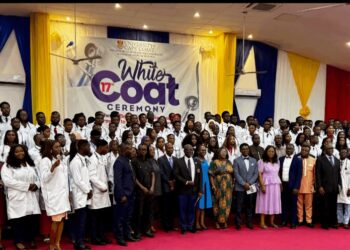
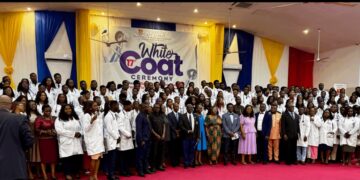











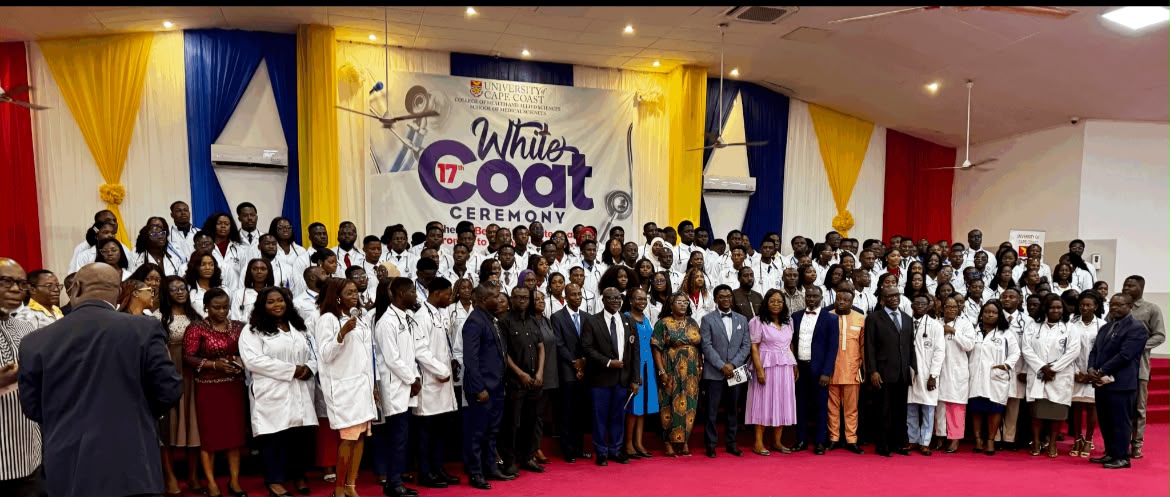
Students of the University of Cape Coast (UCC) School of Medical Sciences have been challenged to approach their medical training with a strong commitment to service, compassion, scientific inquiry and addressing inequalities in healthcare.
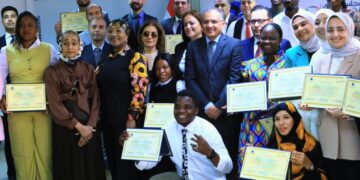
The call was made at the 17th White Coat Ceremony of the School of Medical Sciences, UCC, marking the students’ transition into the clinical phase of their medical education.
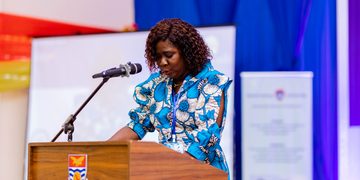
The Acting Pro-Vice-Chancellor of UCC, Prof. Christine Adu-Yeboah, urged the students to ask difficult and systemic questions about access to healthcare, particularly for poor and vulnerable populations. She said such questioning was necessary to help build a better nation.
Prof. Adu-Yeboah said the university management remains committed to strengthening the School of Medical Sciences and its training programmes.
She noted that the School has employed a problem-based and community-oriented approach since 2008, adding that the university would continue to enhance research capacity, clinical training conditions and interdisciplinary collaboration.
Meanwhile, the Dean of the School of Medical Sciences, Prof. Patrick Kafui Akakpo emphasized the importance of professionalism and accountability as students begin their clinical years. He said medical education goes beyond textbooks and depends significantly on patients who allow students to learn from their experiences.
According to him, the white coat should not be viewed as a symbol of status but as a symbol of service and accountability. Prof. Akakpo also reminded the students of their responsibility to patients, stressing that healthcare professionals must remain attentive and responsive when patients seek help.
“Without patients, be reminded, there is no medical education. Their courage becomes your classroom, but with this privilege comes responsibility,” he continued.
He further acknowledged the sacrifices of parents and guardians, describing their support as an important part of the students’ journey into medicine. Also speaking at the ceremony, Dr. Philip Anderson encouraged the students to see the white coat as a beginning rather than a boundary to their careers.
Drawing from his own journey from clinical practice into the biopharmaceutical industry and global health leadership, Dr. Anderson said medical graduates could pursue diverse careers while still contributing to human health.
He urged the students to remain grounded in scientific evidence and contribute to research that addresses health challenges in African populations. Dr. Anderson said Ghana and Africa must move beyond being consumers of knowledge produced elsewhere, noting that some of medicine’s unanswered questions require African scientists to provide the answers.
He also highlighted the importance of compassion in an era of increasing technological and artificial intelligence capabilities, saying technology may support diagnosis but cannot replace the human connection between a healthcare professional and a patient.
The 17th White Coat Ceremony marked not only the students’ entry into clinical training but also a renewed call for them to combine medical knowledge with professionalism, compassion, research and service to society.
READ ALSO: GSA’s 20th Biennial Workshop Calls for Science-Driven Action on Ghana’s Blue Economy
Source: Angelina Riley Hayford/ATLFMNEWS