









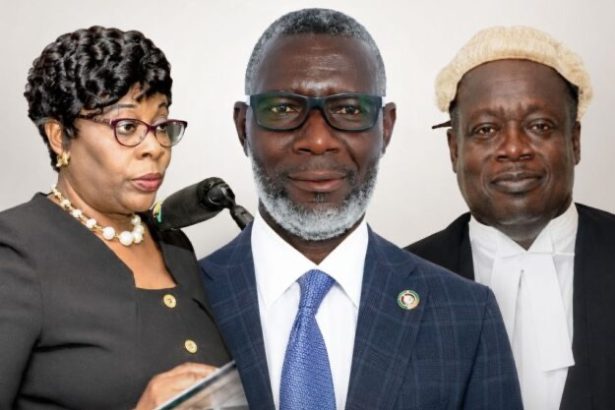
Three nominees selected by President John Dramani Mahama for appointment to Ghana’s Supreme Court have received parliamentary approval, clearing an important stage in the constitutional appointment process.
The approved nominees are Court of Appeal judges Justice Sophia Rosetta Bernasko Essah and Justice Edward Amoako Asante, as well as private legal practitioner Anthony Forson Junior.
Parliament endorsed the nominees after adopting a report from the Appointments Committee, which recommended their approval following public vetting.
The decision moves all three nominees closer to formally joining the Supreme Court.
Parliament Adopts Committee Report
The Appointments Committee submitted its report to the House after examining the nominees professional experience, legal knowledge and suitability for service on the country’s highest court.
Parliament subsequently adopted the committee’s recommendation and approved all three candidates.
Majority Leader Mahama Ayariga congratulated the nominees and commended the manner in which they responded to questions during the vetting process.
He maintained that their professional backgrounds and performance before the committee justified the recommendation for approval.
Read Also: AFAG Questions Value for Money in GoldBod Expenditure
The approval means Justice Bernasko Essah, Justice Amoako Asante and Mr Forson have successfully completed the parliamentary stage of the process.
Two Court of Appeal Judges Approved
Justice Sophia Rosetta Bernasko Essah and Justice Edward Amoako Asante currently serve on the Court of Appeal.
Their nomination to the Supreme Court represents a potential elevation from the second-highest level of Ghana’s judiciary to the apex court.
If the remaining constitutional procedures are completed, they will join the Supreme Court with experience gained from adjudicating cases at the appellate level.
Anthony Forson Junior, meanwhile, was nominated from private legal practice, bringing a different professional background to the proposed appointments.
The combination of judges from the Court of Appeal and a lawyer from private practice is expected to add varied legal experience to the Supreme Court.
Minority Walks Out of Vetting
The approval followed a contentious vetting process that saw members of the Minority Caucus withdraw from the proceedings.
The Minority objected to the timetable and manner in which the vetting exercise was organized, arguing that the process was being rushed.
Minority Leader Alexander Afenyo-Markin said Parliament had not been given sufficient time to conduct detailed scrutiny or allow adequate public participation.
He argued that appointments to the Supreme Court required careful examination because of the far-reaching constitutional responsibilities of the court.
The Minority subsequently walked out of the exercise after its concerns were not addressed to its satisfaction.
Objection Was Against Process, Not Nominees
Mr Afenyo-Markin clarified that the Minority’s protest was not directed at the professional competence or personal suitability of the three nominees.
He also stressed that the Caucus was not challenging President Mahama’s constitutional authority to nominate persons for appointment to the Supreme Court.
According to him, the Minority’s concerns related solely to the speed, timetable and procedures adopted by the Appointments Committee.
The distinction means the walkout was intended as a protest against the conduct of the vetting rather than a rejection of Justice Bernasko Essah, Justice Amoako Asante or Anthony Forson Junior.
Despite the Minority’s withdrawal, the committee continued its work and later presented its recommendations to the full House.
Nominees Move to Final Appointment Stage
Parliament’s approval clears the nominees to proceed to the remaining stage of the constitutional appointment process.
Their appointments will be completed after the required formalities are undertaken.
Once formally appointed, the three will join a court responsible for interpreting the Constitution, determining significant legal disputes and serving as Ghana’s final appellate body.
Their approval comes amid continuing public discussion about the composition of the Supreme Court and the procedures Parliament applies when scrutinizing appointments to the superior courts.
Vetting Dispute May Continue
Although the nominees have secured parliamentary approval, the Minority’s objections are likely to sustain debate over the work of the Appointments Committee.
The disagreement raises broader questions about how Parliament should balance timely consideration of nominations with the need for thorough scrutiny and public participation.
The Majority maintained that the nominees were adequately examined and had demonstrated their suitability for the positions.
The Minority, however, insisted that the importance of Supreme Court appointments required more time and a more deliberate process.
With Parliament’s decision now taken, attention will turn to the completion of the appointments and the eventual assumption of office by the three nominees.