















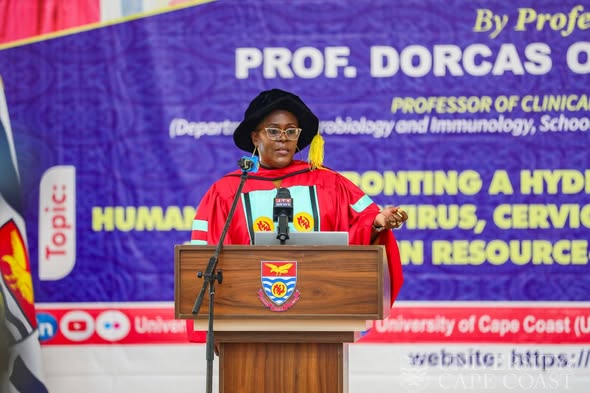
A Professor of Clinical Microbiology at the University of Cape Coast, Professor Dorcas Obiri Yeboah, has raised concerns over the widespread prevalence of the Human Papilloma Virus (HPV), warning that a significant proportion of the global population is at risk of infection.
Delivering her inaugural lecture at the University of Cape Coast, Professor Obiri Yeboah revealed that one in three men carries genital HPV, while a large number of adults are expected to contract the virus at some point in their lifetime.
“Four out of five adults will have an HPV infection at some point in their lives,” she stated, emphasizing that the virus remains one of the most common sexually transmitted infections worldwide.
Her lecture, titled “Confronting a Hydra-Headed Problem: Human Papilloma Virus, Cervical Cancer and the Quest for Elimination in Resource-Constrained Settings,” highlighted the serious public health implications of HPV, particularly its link to cervical cancer.
Professor Obiri Yeboah stressed that men are not exempt from the infection, despite the widespread perception that HPV mainly affects women, noting “If the men think that because we are talking about cervical cancer they are out of the story, please, one in three men are infected with genital HPV.”
She called for greater urgency in addressing HPV and cervical cancer, especially in developing countries where limited resources often hinder prevention, screening and treatment efforts.
The professor also appealed to the media to intensify public awareness campaigns, describing journalists as key partners in educating the public and encouraging people to seek screening services.
“You have the loudest voices. We are begging the media to partner us because we need to create demand and get people to ask for cervical screening at health facilities,” she said.
According to her, cervical cancer remains one of the most preventable cancers if early detection and vaccination efforts are strengthened.
Chairing the lecture, Acting Vice-Chancellor of the University of Cape Coast, Professor Dennis Worlanyo Aheto, described inaugural lectures as an important tradition within academia.
He explained that the event represents a defining milestone in the career of a professor and provides an opportunity for scholars to share their research and insights with the broader academic community.
The lecture forms part of ongoing efforts within the university to promote research and stimulate national discussions on critical public health challenges.
Read More @ ATLFMNEWS.COM