










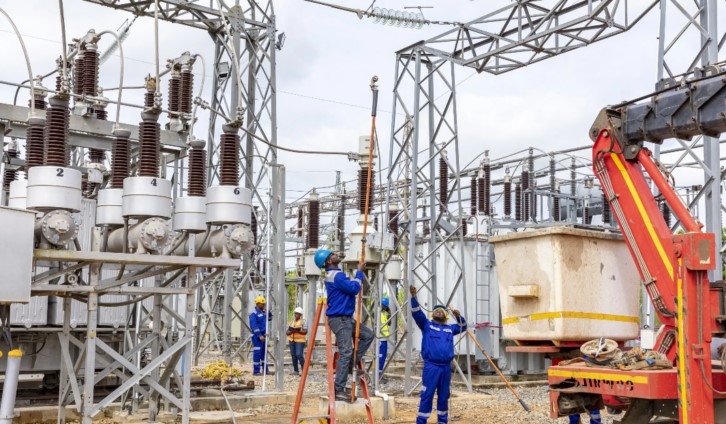
The Government of Ghana says it has taken decisive steps to stabilize the energy sector and rebuild investor confidence after settling major legacy debts and fully restoring the World Bank’s Partial Risk Guarantee within its first year in office.
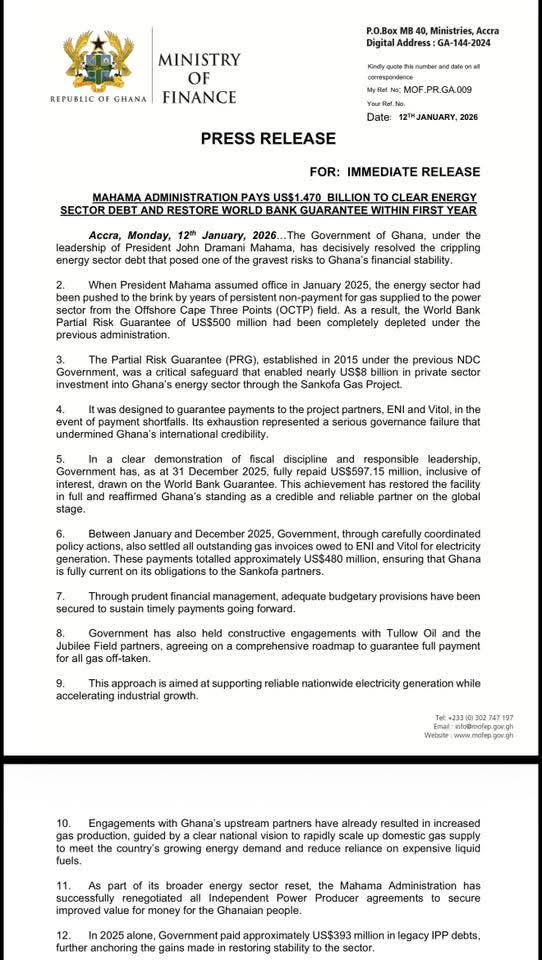
In a statement issued on Monday, January 12, 2026, the Ministry of Finance disclosed that a total of US$1.47 billion has been paid to clear accumulated energy sector obligations, reversing what it described as years of financial neglect that had pushed the sector to the edge of collapse.
According to the Ministry, the Mahama administration inherited an energy sector burdened by unpaid gas bills linked to supplies from the Offshore Cape Three Points (OCTP) field. The prolonged non-payment had resulted in the complete drawdown of the US$500 million World Bank Partial Risk Guarantee, a development that severely weakened Ghana’s credibility with international partners.
The guarantee, which was put in place in 2015, played a key role in mobilizing nearly US$8 billion in private investment for the Sankofa Gas Project. Its depletion, the Ministry noted, amounted to a major governance lapse with far-reaching implications for investor trust.
“As at December 31, 2025, government had fully repaid US$597.15 million, including interest, drawn under the World Bank Guarantee,” the statement said, stressing that the facility has now been fully reinstated.
The Ministry added that the restoration of the guarantee sends a strong signal to the international community that Ghana is committed to honouring its financial obligations and upholding sound governance standards.
In addition, the government disclosed that outstanding gas supply debts owed to ENI and Vitol, estimated at about US$480 million, have also been settled. Budgetary measures have further been put in place to prevent future arrears and ensure regular payments to energy sector partners.
The Ministry said the combined interventions mark a turning point for the energy sector and are expected to improve liquidity, attract fresh investment, and safeguard the country against future supply disruptions.
Read Statement Below:
Read More Stories @ ATLFMNEWS.COM