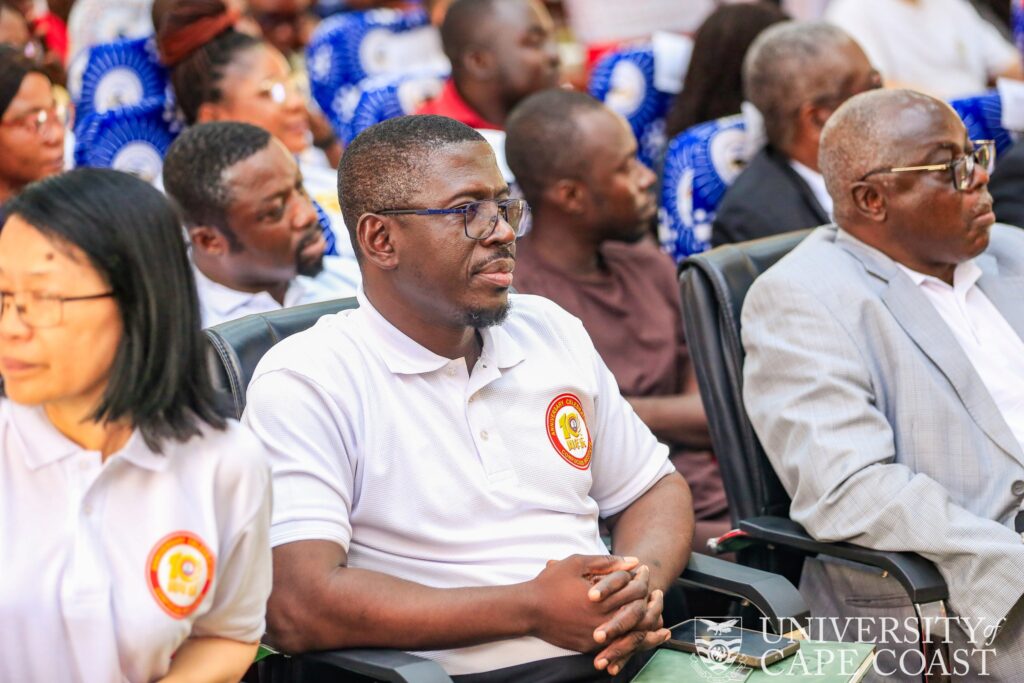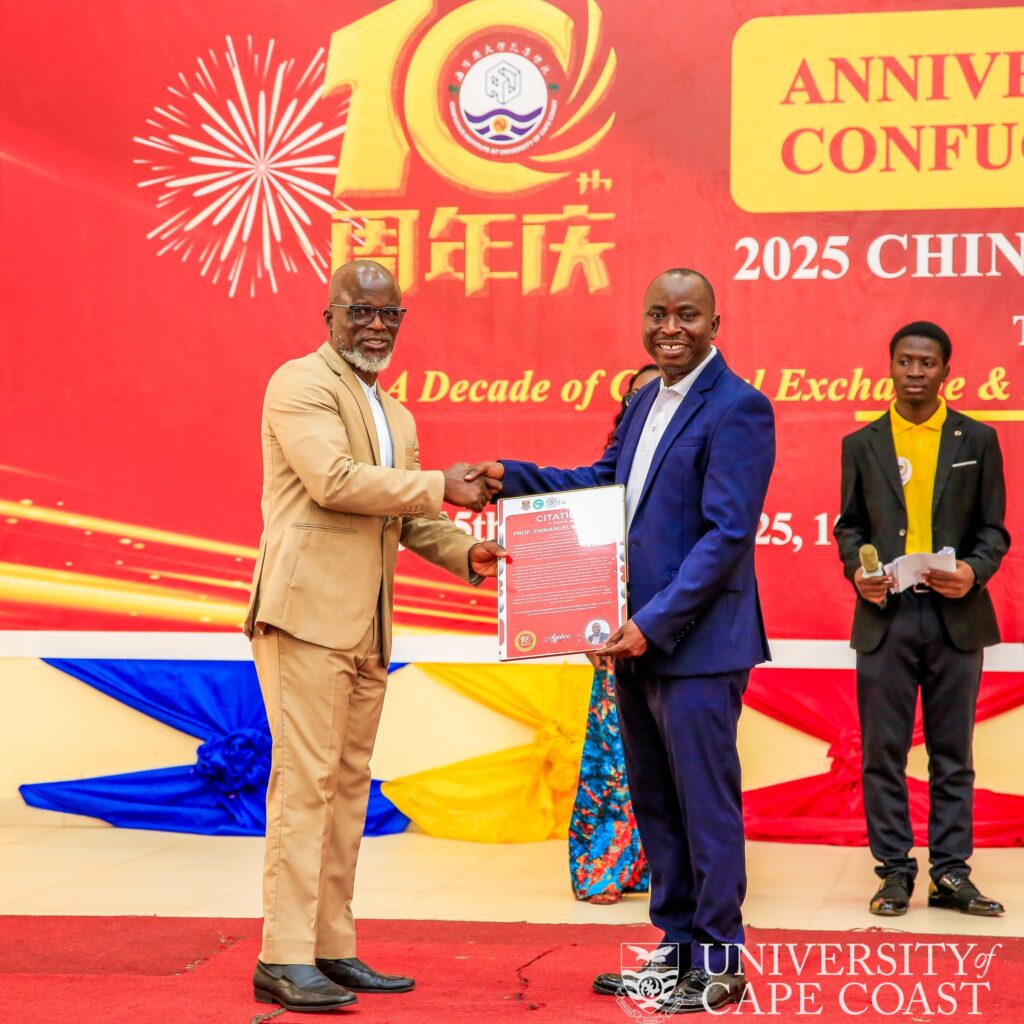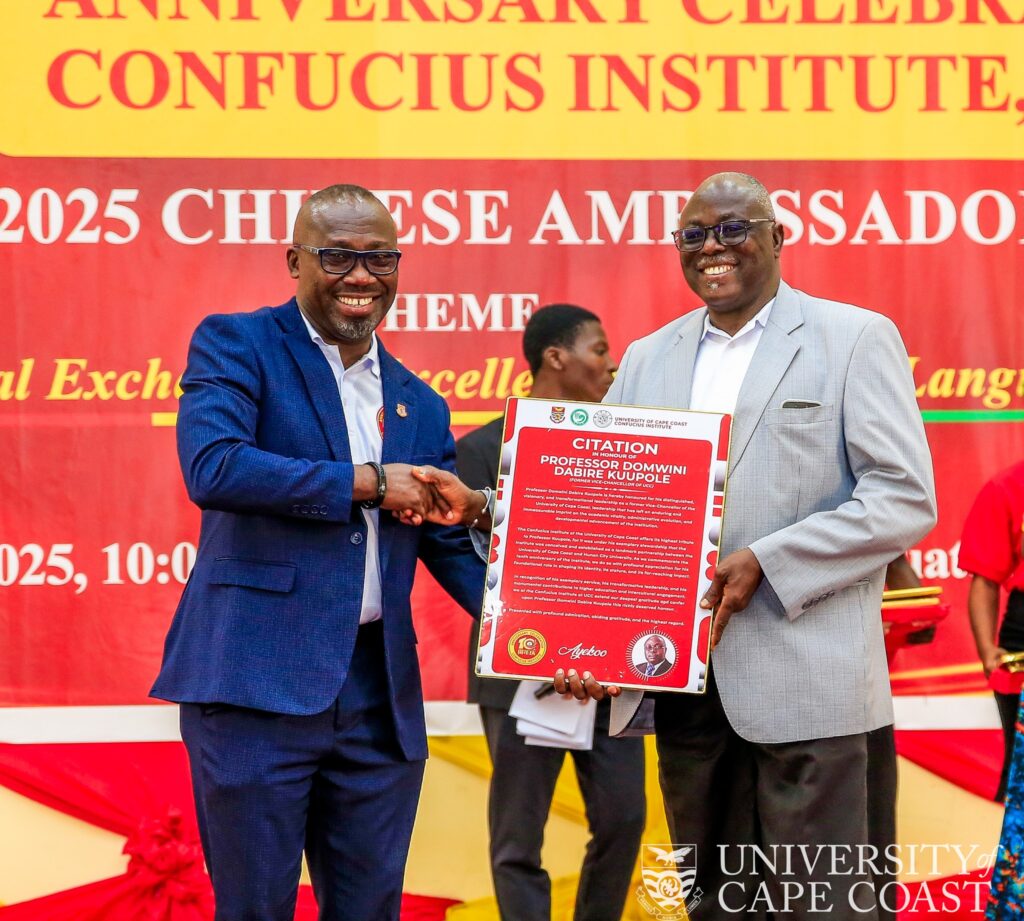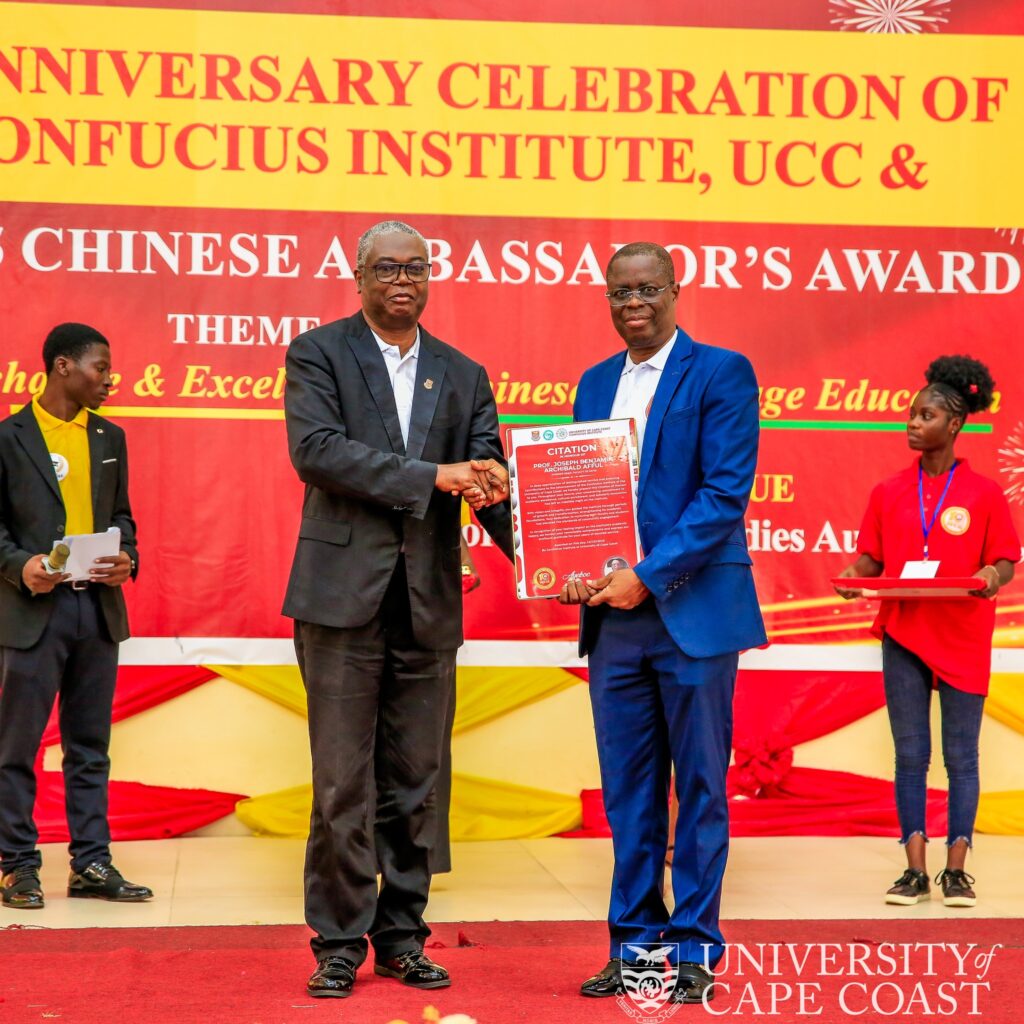



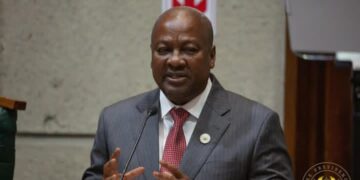









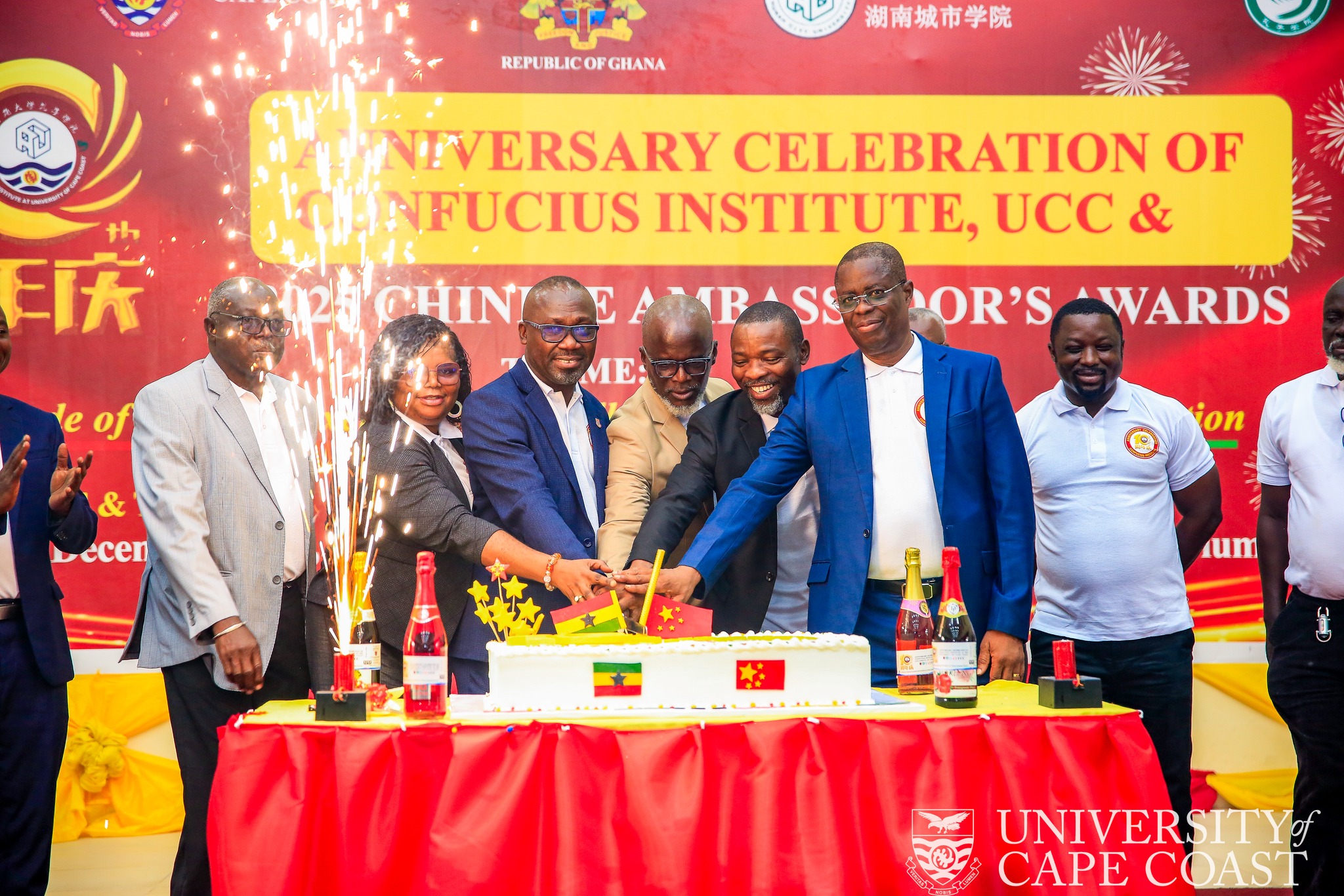
The Director of the Confucius Institute at the University of Cape Coast (UCC), Professor Emmanuel Amo Ofori, has reaffirmed the Institute’s commitment to deepening Ghana-China educational and cultural cooperation as it marks its 10th anniversary and launch of the Chinese Language Curriculum for Ghanaian Basic Schools.
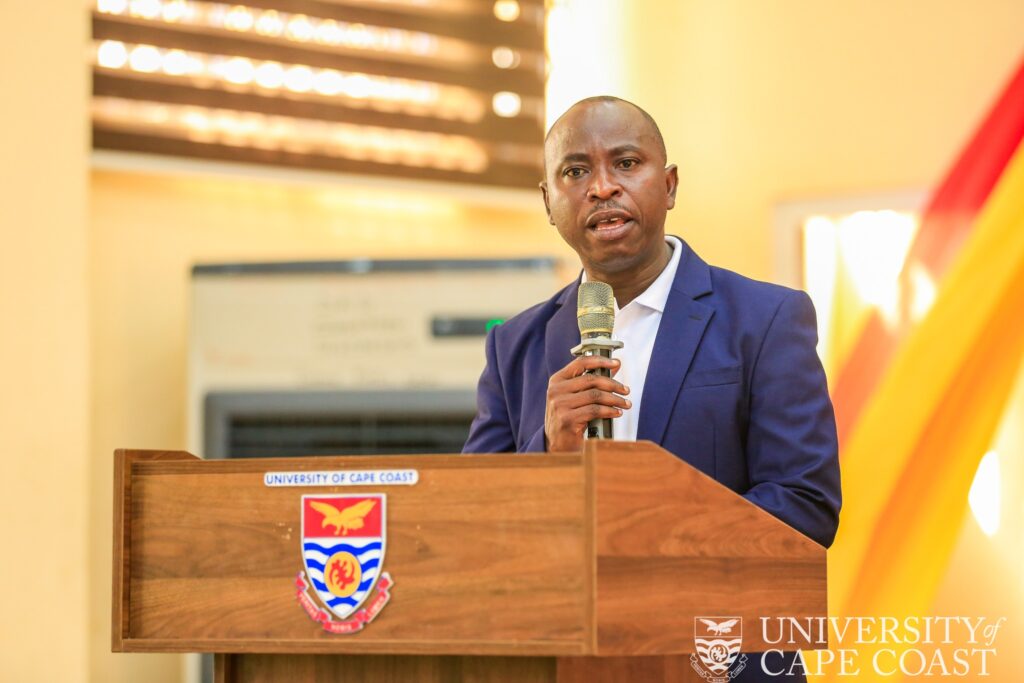
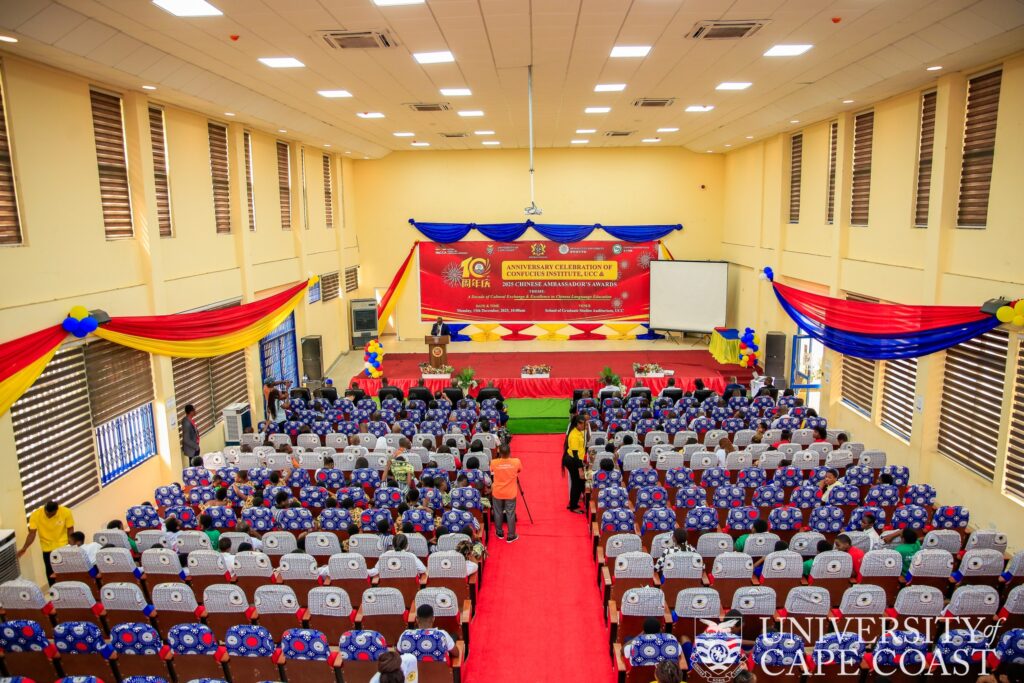
He made the remarks at a colourful ceremony held at the UCC campus to celebrate a decade of cultural exchange and excellence in language education.
The event, which was on the theme “A Decade of Cultural Exchange and Excellence in Chinese Language Education,” also coincided with the 2025 Chinese Ambassador’s Awards.
Celebrating a Decade of Partnership
In his address, Prof. Amo Ofori recounted the Institute’s journey from its inception in 2015, following a partnership between UCC and Hunan City University in China, with approval from the Confucius Institute Headquarters (Hanban).
He said the Institute’s establishment had been the result of years of academic collaboration between the two universities, dating back to 2008, when both institutions began formal exchanges to promote mutual understanding and educational cooperation.
“Ten years ago, we planted a seed of partnership — nurtured by a shared vision of cultural exchange, language learning, and academic collaboration. Today, that seed has grown into a vibrant hub of knowledge and friendship,” he said.
Prof. Amo Ofori commended the University of Cape Coast, Hunan City University, the Chinese Embassy in Ghana, and the Center for Language Education and Cooperation (CLEC) for their support over the years, noting that the Institute had evolved from a small language centre into a regional leader in Chinese cultural and linguistic education.
Expanding Impact
Over the past decade, he said, the Confucius Institute had trained thousands of Ghanaian students in Chinese language and culture, facilitated numerous exchange programmes for students and scholars, and organised cultural festivals that brought Ghanaian and Chinese traditions together.
The Institute has also supported local businesses engaging with Chinese partners and fostered community outreach through academic and cultural dialogue.
“When we open doors through language, we open pathways to new possibilities. When we build partnerships rooted in respect, we build a better future,” Prof. Amo Ofori remarked.
Looking Ahead
Prof. Amo Ofori said the next decade of the Institute’s work would focus on innovation, research collaboration, digital language learning, and community engagement, with a vision to further integrate Chinese studies into Ghana’s academic ecosystem.
“Together with our partners, we will continue to build bridges of knowledge, respect, and friendship. The Confucius Institute at UCC stands as a symbol of Ghana-China cooperation and a model for intercultural education in Africa,” he added.
The Acting Vice-Chancellor of the University of Cape Coast (UCC), Professor Denis Worlanyo Aheto, announced that the Confucius Institute at UCC now trains more than 11,000 students annually, making it one of Ghana’s leading centres for Chinese language education and cultural exchange.
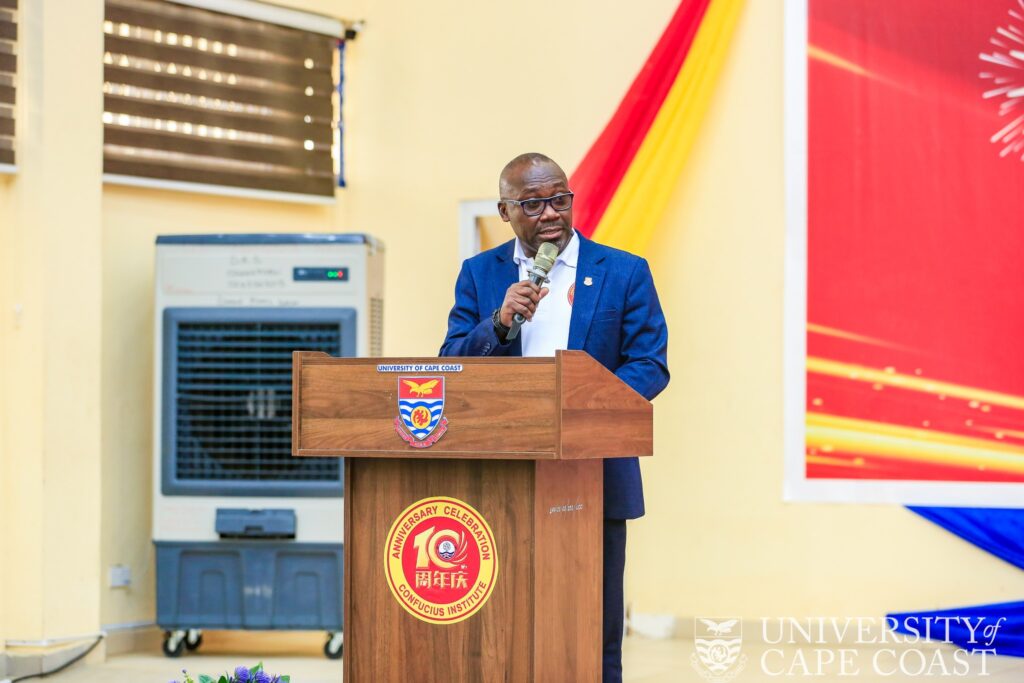
He described the anniversary as “a celebration of growth, partnership, and enduring friendship” between Ghana and China, reflected in the success of the Institute since its establishment in December 2015.
“From a modest beginning to promote Chinese language and culture, the Confucius Institute has evolved into a centre of excellence that has shaped thousands of lives and strengthened Ghana–China educational cooperation,” he said.
Prof. Aheto noted that beyond training students, the Institute had become a hub for multilingual education, cross-cultural understanding, and global citizenship, helping to prepare Ghanaian youth for an interconnected world.
Curriculum Milestone
Highlighting recent achievements, Prof. Aheto announced that the Chinese language would soon be introduced into Ghana’s national basic and secondary school curricula following an agreement between the Ministries of Education of Ghana and China.
Read Also: Fuel prices to fall in big relief for drivers
He revealed that a draft curriculum had already been completed and that the pilot phase would begin soon, adding that UCC, through the Confucius Institute, played a key role in developing the framework.
“This is a national milestone, and UCC’s contribution through the Confucius Institute deserves commendation,” he stated.
Academic and Global Impact
Since 2019, the Institute has run a Bachelor of Arts in Chinese programme, with the first cohort graduating in 2023, including one First-Class honours student. It has also established 17 Confucius Classrooms in schools across the Central and Western regions and introduced a comprehensive online Chinese course to expand access to language learning.
Prof. Aheto celebrated the achievements of students who have excelled globally, including winners of the Chinese Bridge Competition, such as Lilian Ama Tobias, who placed second in the world finals in China, and Charity Tetteh, who represented Ghana at the 2025 global contest.
The Acting Vice-Chancellor also highlighted the Institute’s recognition as an “Excellent Test Center” in 2022, one of only 69 such centres worldwide, for its outstanding performance in Chinese proficiency examinations.
Building Capacity and Partnerships
He further announced that UCC, in collaboration with Hunan City University and the Center for Language Education and Cooperation (CLEC), had established the West Africa Center for Training Local Chinese Teachers, which held its first professional workshop in June 2025.
The Institute, he added, has facilitated academic exchanges, joint research, and high-level visits between Ghana and China, including delegations from Hunan Province, the Sichuan Medical Association, and the People’s Daily newspaper.
It has also hosted China-Africa Urban Development Forums since 2017 and organized job fairs connecting graduates to Chinese enterprises in Ghana.
Looking Ahead
Prof. Aheto commended the directors, faculty, and staff of the Confucius Institute for their dedication, and thanked the Chinese Embassy, CLEC, and Ghanaian education authorities for their continued partnership.
“As we look to the next decade, we reaffirm our commitment to strengthen the Institute, expand its programmes, and deepen our cooperation for the prosperity of both nations,” he said.
Launch of the Chinese Language Curriculum for Basic Schools
National Council for Curriculum and Assessment (NaCCA) Board Chairman, Prof. Vincent Assanful said the introduction of Chinese language education into Ghana’s formal school system reflects a broader shift in how literacy and employability are defined in the 21st century.
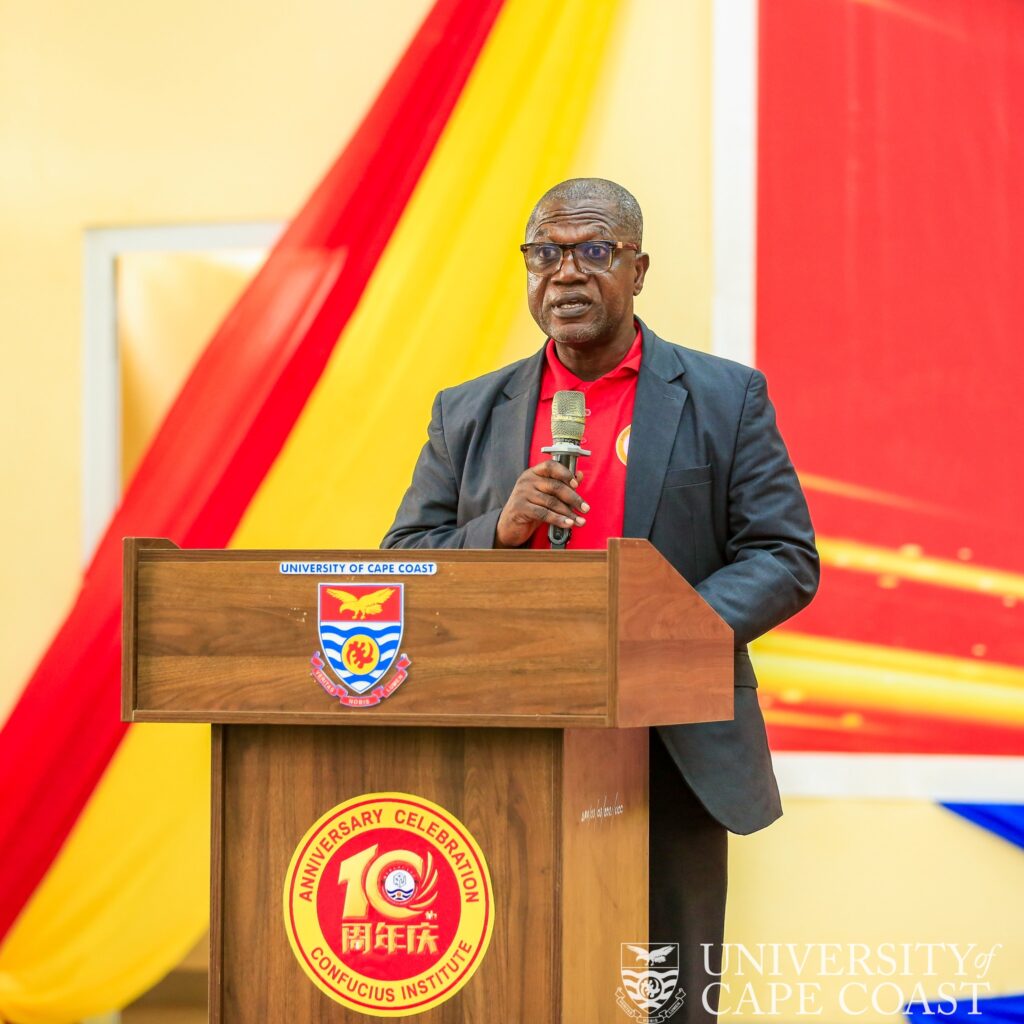
He noted that literacy today extends beyond proficiency in English and local languages to include the ability to communicate across cultures and economic systems.
According to him, NaCCA’s mandate goes beyond curriculum regulation to strategic partnership, aimed at positioning Ghana’s future workforce within the global economic space, particularly in light of China’s growing influence as a major trade and development partner.
Curriculum Built on Practical Competence
He explained that the Chinese language curriculum was developed through months of technical collaboration with the Confucius Institute at UCC, combining pedagogical expertise with cultural context.
The programme is competency-based, prioritising communicative proficiency and functional literacy rather than rote memorisation. It is aligned with Ghana’s Common Core Programme and benchmarked against international standards such as the Hanyu Shuiping Kaoshi (HSK).
Education authorities stressed that the curriculum is not merely academic but also economic in purpose, designed to reduce language barriers in areas such as trade, diplomacy, engineering, healthcare, technology and entrepreneurship.