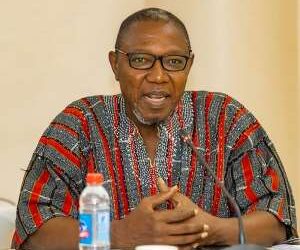
















A Senior Finance Lecturer at the University of Cape Coast Business School, Professor Seyram Kawor, has called on government to intensify strategic investments in critical sectors of the economy if Ghana is to surpass the projected 100-billion-dollar economic threshold.
Speaking to Joy Business, Professor Kawor stressed that sustained growth will require fiscal discipline, deliberate planning and prudent management of public resources.
According to him, sustainable development cannot be achieved without a clear framework outlining how revenue is generated and how it is spent.
“For us to develop and achieve sustainable growth, there is the need for proper planning. You must know where the money is coming from and where you are going to use it,” he stated.
He explained that disciplined public financial management is essential to preventing waste and ensuring optimal outcomes.
Backing Value for Money Office
Professor Kawor welcomed discussions surrounding the proposed Value for Money Office expected to be presented to Parliament by the Ministry of Finance. He believes the initiative could enhance transparency and strengthen procurement systems.
“When we talk about value for money, especially in public procurement, it helps to ensure that resources are not misapplied and that single sourcing is only used in extreme cases,” he noted.
He described procurement reform as a critical step in safeguarding public funds, adding that inefficiencies in that area often deprive the economy of resources that could otherwise be invested productively.
Invest in Education, Agriculture and Industry
The finance lecturer further emphasised the importance of directing investments into priority sectors such as education, agriculture and industry.
“If we want to move from one stage of growth to another, we need to invest in the right sectors of the economy education, agriculture and industry,” he said.
He linked this to government’s 24-hour economy agenda, arguing that industrial expansion must be aligned with broader development planning.
Professor Kawor also highlighted the need for stronger collaboration between industry and educational institutions to ensure that graduates possess skills relevant to the job market.
“Industry must partner with educational institutions to train the human resource they need. That is what will propel growth in industry,” he explained.
He maintained that aligning human capital development with industrial needs will be key to boosting productivity and sustaining economic expansion.
Professor Kawor’s comments come amid ongoing national discussions on fiscal reforms, procurement efficiency and strategies aimed at positioning Ghana for stronger and more resilient long-term economic growth.
Read Also: GREDA: One-Year Rent Advance Is a Reasonable Compromise