












Fresh questions are emerging over a GH¢11 million contract awarded by the Gold Board, as government moves to defend the process amid growing public scrutiny over links to a senior official.
The contract, awarded to Korica Ghana Limited, has drawn attention due to its association with the WESO Group, a company linked to Deputy Chief of Staff Stan Dogbe. The development has triggered debate across political and public spaces, with concerns centred on transparency, fairness and possible conflicts of interest.
But government insists the process was lawful.
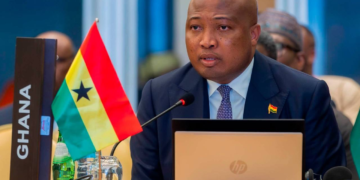
Speaking on Channel One TV, Minister of State in charge of Government Communications Felix Kwakye Ofosu rejected suggestions of wrongdoing, stating that no procurement laws were breached in awarding the contract.
According to him, the Deputy Chief of Staff played no role in the procurement process, and therefore cannot be said to have influenced the outcome.
He explained that the contract — which covers office renovation works — went through a competitive public procurement process, in line with established procedures.
Gov’t Draws the Line on Conflict Claims
Mr. Kwakye Ofosu further clarified that a conflict of interest would only arise if:
- A public official directly participates in awarding a contract
- And stands to benefit from that same decision
He maintains that neither condition applies, insisting that the claims being circulated do not meet the threshold of a legal or procedural breach.
Update: Debate Expands Beyond Legal Definitions
Recent commentary across major news platforms and political discussions suggests the issue is evolving beyond legality into questions of perception and public trust.
Read Also: Illegal Arms Crackdown Intensifies as Gov’t Deploys New Measures
Analysts note that even where procurement rules are followed, contracts involving companies linked to politically exposed persons often attract scrutiny, particularly in a climate where accountability in public spending remains a major public concern.
So far, there has been no indication from regulatory bodies of any formal investigation, and government has not announced any review of the contract.
A Familiar Governance Challenge
The situation reflects a broader, recurring tension in Ghana’s governance space — where the line between legal compliance and public perception becomes a key battleground.
While government continues to defend the process as transparent and competitive, the emergence of new questions suggests the issue may remain in the public spotlight in the days ahead.
For now, officials are standing firm, maintaining that the contract was awarded properly and that no conflict exists under the law.