












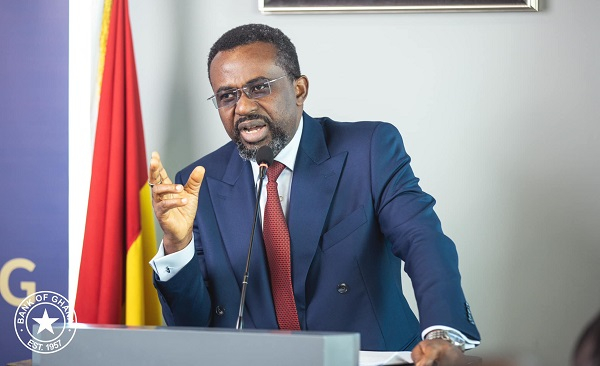
Governor of the Bank of Ghana, Johnson Asiama, has warned that escalating geopolitical tensions in the Middle East could threaten Ghana’s recent gains in reducing inflation.
Speaking at the opening of the 129th meeting of the Monetary Policy Committee, Dr. Asiama explained that although Ghana’s macroeconomic indicators have improved in recent months, developments in the global environment could still influence the country’s economic outlook and the direction of monetary policy.
He noted that rising conflict in the Middle East is beginning to disrupt global energy and shipping routes, creating instability in international oil markets and adding uncertainty to global inflation trends.
“For Ghana, the transmission channels are clear. Sustained oil price increases could raise the risk of imported inflation and tighten global financial conditions,” Dr. Asiama stated.
According to the Governor, higher oil prices triggered by geopolitical tensions could quickly translate into increased domestic inflation through rising import costs. He indicated, however, that global uncertainty could also present some advantages for Ghana through rising gold prices.
“Geopolitical uncertainty tends to support gold prices. Given the importance of gold in our export earnings, this could improve our trade balance,” he explained.
Despite this potential benefit, Dr. Asiama stressed that the balance of risks remains tilted toward inflationary pressures, which the Monetary Policy Committee must take into account in its policy decisions.
The Governor also highlighted Ghana’s current inflation situation, revealing that the country’s inflation rate has now fallen below the Bank of Ghana’s target band, saying “At 3.3 per cent, inflation is not only within the target band but has fallen below its lower limit.”
He explained that this development presents a new challenge for policymakers as they determine the next steps for monetary policy.
Dr. Asiama further disclosed that the committee will assess the government’s newly introduced Ghana Accelerated National Reserve Accumulation Programme, which seeks to significantly increase the country’s foreign reserves.
The programme aims to raise Ghana’s international reserves to the equivalent of 50 months of import cover by 2028, compared with the current level of about 5.8 months.
While he described stronger reserves as crucial for enhancing Ghana’s economic resilience, the Governor cautioned that such programmes could affect liquidity conditions, the central bank’s balance sheet and the conduct of monetary policy.
Touching on the financial sector, Dr. Asiama said Ghana’s banking industry remains stable, profitable and well capitalized, with improvements recorded in asset quality over the past year. However, he noted that credit growth in the sector remains slow.
He said the committee will examine whether the subdued lending is driven by supply-side constraints within banks, including risk appetite and capital buffers, or weak demand from potential borrowers.
Despite the uncertainties, Dr. Asiama acknowledged that Ghana’s economic situation has improved considerably in recent months, noting “The question before the committee is not whether conditions have improved. They have indeed improved significantly across the board.”
Read More Stories @ ATLFMNEWS.COM