















A massive tax discrepancy exceeding GH¢85 million has triggered a major policy shift in Ghana’s import regime, with government directing that all commercial quantities of cooking oil be routed exclusively through the country’s seaports.
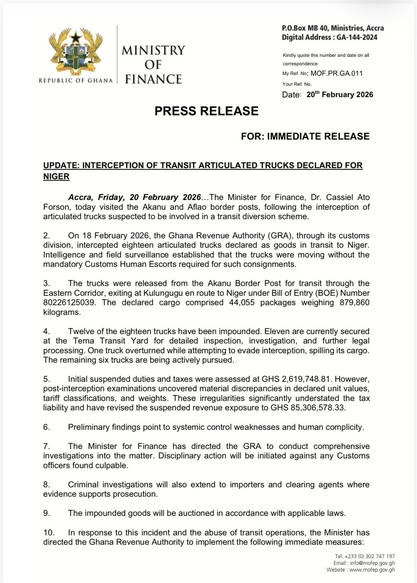
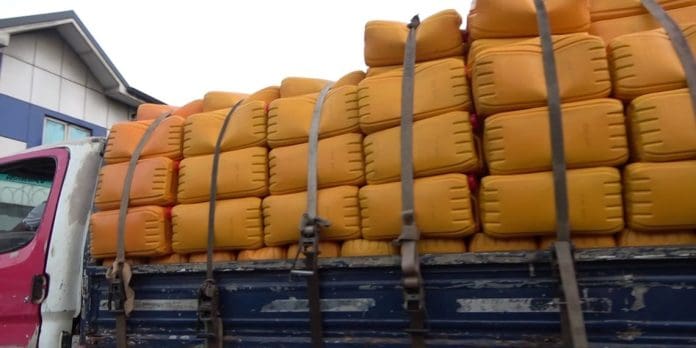
The decision follows a joint late-night operation by the Customs Division of the Ghana Revenue Authority (GRA) and National Security, which intercepted 12 articulated trucks carrying cooking oil, spaghetti and tomato paste.
The cargo had been declared as transit goods bound for Niger but was diverted to the Tema Customs yard for verification.
From GH¢2.6m to GH¢85m
According to the Deputy Finance Minister, Thomas Ampem Nyarko, initial documentation showed taxes assessed at GH¢2.6 million on more than 44,000 packages.
However, a reassessment revealed that the actual tax liability should have exceeded GH¢85 million — a dramatic difference that officials say exposes serious vulnerabilities in the transit system.
Further investigation revealed that while the official reference price for edible oil was set at $20.50, customs documentation used a significantly lower valuation of $12 to calculate duties, sharply reducing the payable tax.
The Deputy Minister described the development as “deeply troubling,” suggesting the practice could be more widespread than initially believed.
Transit Loophole Exploited
Authorities are questioning why goods allegedly travelling from Togo to Niger would pass through Ghana, raising suspicions that the transit declaration may have been used to disguise goods intended for the local market.
Under existing directives, high-risk commodities such as edible oil, tomato paste, spaghetti, rice and sugar are prohibited from entering Ghana through land borders for domestic import.
Related Article: Massive GH¢85m Transit Fraud Foiled by GRA, National Security
However, transit goods were not previously covered under that restriction — a loophole importers are alleged to have exploited.
Seaport-Only Policy Introduced
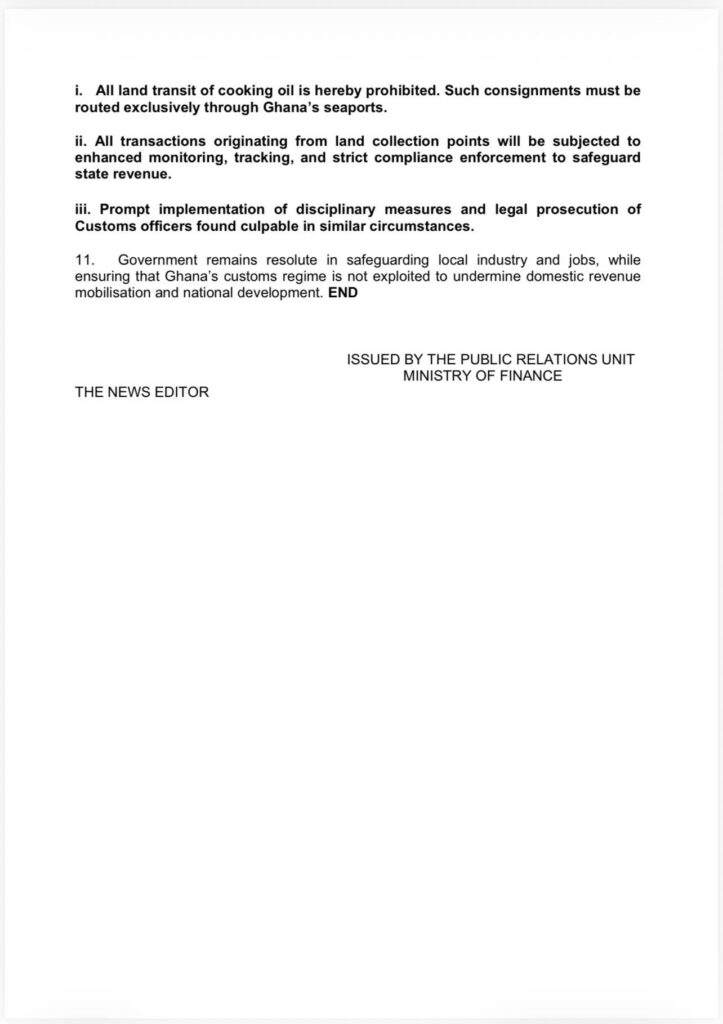
In response, government has now directed that all commercial quantities of cooking oil must enter Ghana exclusively through seaports, where valuation checks and monitoring systems are more stringent.
Officials say the measure aims to:
- Strengthen revenue protection
- Prevent under-valuation practices
- Close transit declaration loopholes
- Reduce diversion of goods into the domestic market
The move forms part of broader efforts to clamp down on revenue leakages at ports and trade corridors.
Wider Revenue Implications
Analysts say the GH¢85 million tax exposure underscores the potential scale of revenue losses if transit protocols are abused.
The Commissioner-General of the Ghana Revenue Authority, Anthony Kwasi Sarpong, has assured that investigations will be completed within one week.
Of the 18 trucks suspected to be involved, 12 were intercepted, while six remain unaccounted for.
Authorities have not ruled out further enforcement actions or additional policy adjustments depending on the findings of the ongoing probe.
The latest directive signals a tightening of import controls as government seeks to safeguard revenue mobilisation amid growing concerns over customs compliance.
READ FULL STATEMENT BELOW