
















//GA4 analytics
  • Home
  • Privacy & Policy
  • Contact
  • Media
  • CratesHub.com
  • Audio on Demand
ATL FM NewsRoom
  • Home
  • Featured
    Government Targets ‘No Bed Syndrome’ with New Health Tech System

    Government Targets ‘No Bed Syndrome’ with New Health Tech System

    Fuel Prices Reduced As Cedi Stability Keeps Costs Down

    Fuel Prices Reduced As Cedi Stability Keeps Costs Down

    The National Anti-Illegal Mining Operations Secretariat (NAIMOS) has stepped up its nationwide crackdown on illegal mining, seizing equipment and making arrests as part of intensified efforts to curb galamsey activities.

    Security Threat Deepens as 94 Excavators Retrieved from Illegal Miners

    Dust on Kasoa–Winneba Road Is Causing Health Fears Now

    Dust on Kasoa–Winneba Road Is Causing Health Fears Now

    slavery

    President Mahama Justifies Resolution Against Slavery and Colonialism

    Catholic Bishops Raise New Legal Challenge in Wesley Girls Case

    Catholic Bishops Raise New Legal Challenge in Wesley Girls Case

    Blow Chem donates to Muslim Community in Cape Coast

    Blow Chem donates to Muslim Community in Cape Coast

    Ghana

    Ghana Becomes First African Nation to Sign Strategic Security Pact with EU

    Oil

    Oil price falls as Trump talks up Iran peace negotiations

  • News
    • All
    • Africa News
    • Business
    • International
    • Local News
    Shock as dozens of bodies, mostly infants, discovered in Kenya mass grave

    Shock as dozens of bodies, mostly infants, discovered in Kenya mass grave

    Col Michael Randrianirina seized power last October in the wake of youth-led protests

    Madagascar military leader dissolves government in surprise move

    US nationals urged to leave Middle East as conflict spreads

    US nationals urged to leave Middle East as conflict spreads

    Minority demands urgent review of the 2025 Common Fund plan

    Minority demands urgent review of the 2025 Common Fund plan

    Girl, 14, shot dead as South Africa’s ‘taxi wars’ hit school

    Girl, 14, shot dead as South Africa’s ‘taxi wars’ hit school

    Senegal PM proposes tougher anti-LGBT law, doubling prison terms

    Senegal PM proposes tougher anti-LGBT law, doubling prison terms

  • Politics
  • Sports
  • Entertainment
  • Technology
  • Lifestyle
  • Opinions
  • MediaAudio
    • All
    • Agyanom Afarifo
    • Cross Current
    • Sports Pai Mu Kan
    • Thursdays Sports

    Thursday Afternoon Sports

    Agoro Nie Pae Mu Ka

    Cross Current

    Agyanom Afarifo

  • Contact Us
  • About us
No Result
View All Result
  • Home
  • Featured
    Government Targets ‘No Bed Syndrome’ with New Health Tech System

    Government Targets ‘No Bed Syndrome’ with New Health Tech System

    Fuel Prices Reduced As Cedi Stability Keeps Costs Down

    Fuel Prices Reduced As Cedi Stability Keeps Costs Down

    The National Anti-Illegal Mining Operations Secretariat (NAIMOS) has stepped up its nationwide crackdown on illegal mining, seizing equipment and making arrests as part of intensified efforts to curb galamsey activities.

    Security Threat Deepens as 94 Excavators Retrieved from Illegal Miners

    Dust on Kasoa–Winneba Road Is Causing Health Fears Now

    Dust on Kasoa–Winneba Road Is Causing Health Fears Now

    slavery

    President Mahama Justifies Resolution Against Slavery and Colonialism

    Catholic Bishops Raise New Legal Challenge in Wesley Girls Case

    Catholic Bishops Raise New Legal Challenge in Wesley Girls Case

    Blow Chem donates to Muslim Community in Cape Coast

    Blow Chem donates to Muslim Community in Cape Coast

    Ghana

    Ghana Becomes First African Nation to Sign Strategic Security Pact with EU

    Oil

    Oil price falls as Trump talks up Iran peace negotiations

  • News
    • All
    • Africa News
    • Business
    • International
    • Local News
    Shock as dozens of bodies, mostly infants, discovered in Kenya mass grave

    Shock as dozens of bodies, mostly infants, discovered in Kenya mass grave

    Col Michael Randrianirina seized power last October in the wake of youth-led protests

    Madagascar military leader dissolves government in surprise move

    US nationals urged to leave Middle East as conflict spreads

    US nationals urged to leave Middle East as conflict spreads

    Minority demands urgent review of the 2025 Common Fund plan

    Minority demands urgent review of the 2025 Common Fund plan

    Girl, 14, shot dead as South Africa’s ‘taxi wars’ hit school

    Girl, 14, shot dead as South Africa’s ‘taxi wars’ hit school

    Senegal PM proposes tougher anti-LGBT law, doubling prison terms

    Senegal PM proposes tougher anti-LGBT law, doubling prison terms

  • Politics
  • Sports
  • Entertainment
  • Technology
  • Lifestyle
  • Opinions
  • MediaAudio
    • All
    • Agyanom Afarifo
    • Cross Current
    • Sports Pai Mu Kan
    • Thursdays Sports

    Thursday Afternoon Sports

    Agoro Nie Pae Mu Ka

    Cross Current

    Agyanom Afarifo

  • Contact Us
  • About us
No Result
View All Result
ATL FM NewsRoom
No Result
View All Result
--Advertisements--
Home Tech

The cement that could turn your house into a giant battery

Mabel Boamah by Mabel Boamah
2 years ago
in Tech
0
The cement that could turn your house into a giant battery
0
SHARES
Share on FacebookShare on Twitter
--Advertisements--

Concrete is perhaps the most commonly used building material in the world. With a bit of tweaking, it could help to power our house too.

On a laboratory bench in Cambridge, Massachusetts, a stack of polished cylinders of black-coloured concrete sit bathed in liquid and entwined in cables. To a casual observer, they aren’t doing much. But then Damian Stefaniuk flicks a switch. The blocks of human-made rock are wired up to an LED – and the bulb flickers into life.

--Advertisements--

“At first I didn’t believe it,” says Stefaniuk, describing the first time the LED lit up. “I thought that I hadn’t disconnected the external power source, and that was why the LED was on. 

“It was a wonderful day. We invited students, and I invited professors to see, because at first they didn’t believe that it worked either.”

--Advertisements--

The reason for the excitement? This innocuous, dark lump of concrete could represent the future of energy storage.

The promise of most renewable energy sources is that of endless clean power, bestowed on us by the Sun, wind and sea. 

Yet the Sun isn’t always shining, the wind isn’t always blowing, and still waters do not, in megawatt terms, run deep. These are energy sources that are intermittent, which, in our energy-hungry modern world, poses a problem.

It means that we need to store that energy in batteries. But batteries rely on materials such as lithium, which is in far shorter supply than is likely to be needed to meet the demand created by the world’s quest to decarbonise its energy and transport systems. There are 101 lithium mines in the world, and economic analysts are pessimistic about the ability of these mines to keep up with growing global demand. Environmental analysts note that lithium mining uses a lot of energy and water, which nibble away at the environmental benefits of switching to renewable energy sources in the first place. The processes involved in extracting lithium can also sometimes lead to toxic chemicals leaking into local water supplies.

Despite some new discoveries of lithium reserves, the finite supply of this material, the over-reliance on just a handful of mines around the world and its environmental impact have driven the search for alternative battery materials.

This is where Stefaniuk and his concrete come in. He and his colleagues at Massachusetts Institute of Technology (MIT) have found a way of creating an energy storage device known as a supercapacitor from three basic, cheap materials – water, cement and a soot-like substance called carbon black.
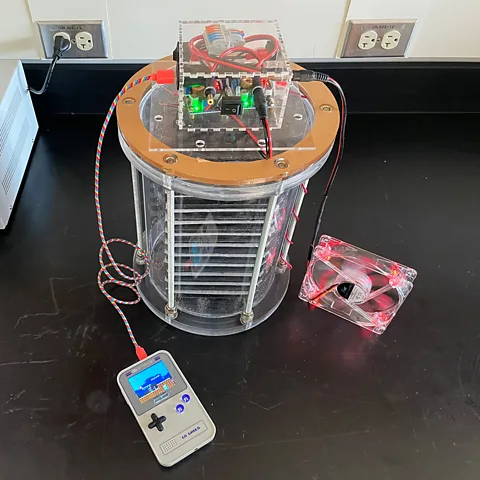
Damian Stefaniuk Damian Stefaniuk has been able to use a carbon cement supercapacitor to power a handheld gaming device (Credit: Damian Stefaniuk)
Damian Stefaniuk has been able to use a carbon cement supercapacitor to power a handheld gaming device (Credit: Damian Stefaniuk)

Supercapacitors are highly efficient at storing energy but differ from batteries in some important ways. They can charge much more quickly than a lithium ion battery and don’t suffer from the same levels of degradation in performance. But supercapacitors also release the power they store rapidly, making them less useful in devices such as mobile phones, laptops or electric cars where a steady supply of energy is needed over an extended period of time.

Yet according to Stefaniuk, carbon-cement supercapacitors could make an important contribution to efforts to decarbonise the global economy. “If it can be scaled up, the technology can help solve an important issue – the storing of renewable energy,” he says.

He and his fellow researchers at MIT and Harvard University’s Wyss Institute for Biologically Inspired Engineering, envisage several applications for their supercapacitors. 

One might be to create roads that store solar energy and then release it to recharge electric cars wirelessly as they drive along a road. The rapid release of energy from the carbon-cement supercapacitor would allow vehicles to get a rapid boost to their batteries. Another would be as energy-storing foundations of houses – “to have walls, or foundations, or columns, that are active not only in supporting a structure, but also in that energy is stored inside them”, says Stefaniuk.

But it is still early days. For now, the concrete supercapacitor can store a little under 300 watt-hours per cubic metre – enough to power a 10-watt LED lightbulb for 30 hours. 

The power output “may seem low compared to conventional batteries, [but] a foundation with 30-40 cubic metres (1,060-1,410 cubic feet) of concrete could be sufficient to meet the daily energy needs of a residential house”, says Stefaniuk. “Given the widespread use of concrete globally, this material has the potential to be highly competitive and useful in energy storage.”

Cement production is responsible for 5-8% of carbon dioxide emissions from human activity globally

Stefaniuk and his colleagues at MIT initially proved the concept by creating cent-sized 1V supercapacitors from the material before connecting together in series to power a 3V LED. They have since scaled this up to produce a 12V supercapacitor. Stefaniuk has also been able to use larger versions of the supercapacitor to power a handheld games console.

And the research team are now planning to build larger versions, including one up to 45 cubic metres (1,590 cubic feet) in size that would be able store around 10kWh of energy needed to power to power a house for a day. 

The supercapacitor works due to an unusual property of carbon black – it is highly conductive. This means that when carbon black is combined with cement powder and water, it makes for a kind of concrete that is full of networks of conductive material, taking a form that resembles ever-branching, tiny roots.

Capacitors are formed of two conductive plates with a membrane in between them. In this case, both plates are made of the carbon black cement, which were soaked in an electrolyte salt called potassium chloride.

When an electric current was applied to the salt-soaked plates, the positively-charged plates accumulated negatively charged ions from the potassium chloride. And because the membrane prevented charged ions from being exchanged between the plates, the separation of charges created an electric field. 

As supercapacitors can accumulate large amounts of charge very quickly, it could make the devices useful for storing excess energy produced by intermittent renewable sources such as the wind and solar. This would take the pressure off the grid at times when the wind is not blowing, nor the Sun shining. As Stefaniuk says, “A simple example would be an off-grid house powered by solar panels: using solar energy directly during the day and the energy stored in, for example, the foundations during the night.”

Supercapacitors are not perfect. Existing iterations discharge power quickly, and are not ideal for steady output, which would be needed to power a house throughout the day. Stefaniuk says he and his colleagues are working on a solution that would allow their carbon-cement version to be tuned by adjusting the mixture, but they will not disclose the details until they have finalised the tests and published a paper.
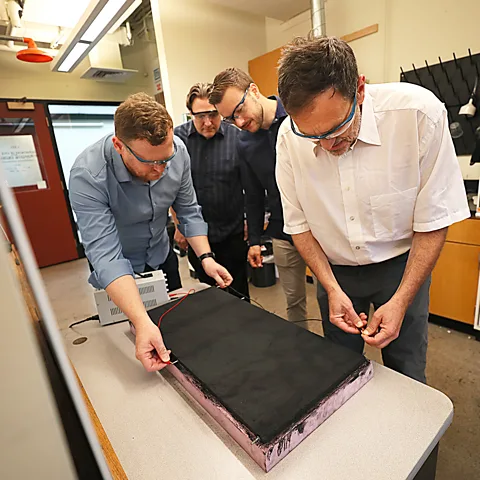
Getty Images The researchers at MIT are working on scaling up their carbon cement supercapactor so it can be used in a number of different applications (Credit: Getty Images)
The researchers at MIT are working on scaling up their carbon cement supercapactor so it can be used in a number of different applications (Credit: Getty Images)

There could be other issues to overcome too – adding more carbon black allows the resulting supercapacitor to store more energy, but it also makes the concrete slightly weaker too. The researchers say any uses that have a structural role to play as well as energy storage would need to find an optimum mix of carbon black.

And while carbon-cement supercapacitors could help to reduce our reliance on lithium, they come with their own environmental impact. Cement production is responsible for 5-8% of carbon dioxide emissions from human activity globally, and the carbon-cement needed for the supercapacitors would need to be freshly made rather than retrofitted in existing structures.

Nevertheless, it seems to be a promising innovation, says Michael Short, who leads the Centre for Sustainable Engineering at Teesside University in the UK. The research “opens many interesting potential avenues around the use of the built environment itself as an energy storage medium”, he says. “As the materials are also commonplace and the manufacture relatively straightforward, this gives a great indication that this approach should be investigated further and could potentially be a very useful part of the transition to a cleaner, more sustainable future.”

Read Also: ‘Serial killer’ arrested after bodies found in Kenya dump

But more research will be needed to move this from the laboratory into the real world.

“Often, new discoveries are problematic when considerations are made to move from lab or bench scale to wider deployment at larger scales and volumes. This can be due to manufacturing complexities, resource scarcities, or sometimes due to the underlying physics or chemistry. Desirable properties occurring at smaller scales may reduce or even vanish when attempts are made to make it larger.”

But there may be a way of overcoming the problem of environmentally-unfriendly cement, adds Short. His colleagues at Teesside University are already working on low-emissions cement that is made from the by-products of the steel and chemical industries.

Projects such as low-emissions cement and energy-storing concrete raise the prospect of a future where our offices, roads and homes play a significant part in a world powered by clean energy.

CLICK HERE FOR MORE STORIES

SOURCE: BBCNEWS

Mabel Boamah

Mabel Boamah

Listen Live

ATL FM Live Streaming
Your browser does not support the audio element.

Stay Connected test

  • 1.9k Followers
  • 1000 Subscribers
  • Trending
  • Comments
  • Latest
IEPA

IEPA Calls for Ethical AI and Data-Driven Education to Accelerate 2030 SDG Goals

March 10, 2026
Col Michael Randrianirina seized power last October in the wake of youth-led protests

Madagascar military leader dissolves government in surprise move

March 10, 2026
The Acting Director of Public Affairs at the University of Cape Coast (UCC), Dr. Kwabena Antwi-Konadu, has refuted rumours circulating on social media regarding the circumstances surrounding the death of a student on campus.

UCC Mourns Student, Clarifies Circumstances of Tragic Accident

March 9, 2026
Education

Improving Education and Healthcare Infrastructure Remains My Priority – Cape Coast North MP

March 9, 2026
Government Targets ‘No Bed Syndrome’ with New Health Tech System

Government Targets ‘No Bed Syndrome’ with New Health Tech System

0
Fuel Prices Reduced As Cedi Stability Keeps Costs Down

Fuel Prices Reduced As Cedi Stability Keeps Costs Down

0
The National Anti-Illegal Mining Operations Secretariat (NAIMOS) has stepped up its nationwide crackdown on illegal mining, seizing equipment and making arrests as part of intensified efforts to curb galamsey activities.

Security Threat Deepens as 94 Excavators Retrieved from Illegal Miners

0
Dust on Kasoa–Winneba Road Is Causing Health Fears Now

Dust on Kasoa–Winneba Road Is Causing Health Fears Now

0
Government Targets ‘No Bed Syndrome’ with New Health Tech System

Government Targets ‘No Bed Syndrome’ with New Health Tech System

March 25, 2026
Fuel Prices Reduced As Cedi Stability Keeps Costs Down

Fuel Prices Reduced As Cedi Stability Keeps Costs Down

March 25, 2026
The National Anti-Illegal Mining Operations Secretariat (NAIMOS) has stepped up its nationwide crackdown on illegal mining, seizing equipment and making arrests as part of intensified efforts to curb galamsey activities.

Security Threat Deepens as 94 Excavators Retrieved from Illegal Miners

March 25, 2026
Dust on Kasoa–Winneba Road Is Causing Health Fears Now

Dust on Kasoa–Winneba Road Is Causing Health Fears Now

March 25, 2026

Recent News

Government Targets ‘No Bed Syndrome’ with New Health Tech System

Government Targets ‘No Bed Syndrome’ with New Health Tech System

March 25, 2026
Fuel Prices Reduced As Cedi Stability Keeps Costs Down

Fuel Prices Reduced As Cedi Stability Keeps Costs Down

March 25, 2026
The National Anti-Illegal Mining Operations Secretariat (NAIMOS) has stepped up its nationwide crackdown on illegal mining, seizing equipment and making arrests as part of intensified efforts to curb galamsey activities.

Security Threat Deepens as 94 Excavators Retrieved from Illegal Miners

March 25, 2026
Dust on Kasoa–Winneba Road Is Causing Health Fears Now

Dust on Kasoa–Winneba Road Is Causing Health Fears Now

March 25, 2026

ATL FM LIVE

ATL FM Live Streaming
Your browser does not support the audio element.

We serve you with the most credible and authentic news covering articles, campus, regional, national and international stories.

Follow Us

Browse by Category

  • Africa News
  • Agyanom Afarifo
  • Business
  • Cross Current
  • E-News
  • Featured
  • Foreign News
  • Foreign Sports
  • International
  • Lifestyle
  • Local News
  • Local Sports
  • Media
  • News
  • Opinions
  • Politics
  • Sports
  • Sports Pai Mu Kan
  • Tech
  • Thursdays Sports
  • Uncategorized
  • Video

Recent News

Government Targets ‘No Bed Syndrome’ with New Health Tech System

Government Targets ‘No Bed Syndrome’ with New Health Tech System

March 25, 2026
Fuel Prices Reduced As Cedi Stability Keeps Costs Down

Fuel Prices Reduced As Cedi Stability Keeps Costs Down

March 25, 2026
  • Home
  • Privacy & Policy
  • Contact
  • Media
  • CratesHub.com
  • Audio on Demand

© 2020 ATL FM NEWS - Your source of authentic news. Powered by ATL FM IT Dept

Welcome Back!

Login to your account below

Forgotten Password?

Retrieve your password

Please enter your username or email address to reset your password.

Log In
--Advertisements--

Add New Playlist

No Result
View All Result
  • About us
  • Audio on Demand
  • Contact Us
  • Home
  • Privacy & Policy

© 2020 ATL FM NEWS - Your source of authentic news. Powered by ATL FM IT Dept